
AI for radiology referrals: reduce retyping only after checking accuracy
A proposed staff-reviewed pilot for radiology-centre owners in Egypt: extract administrative fields from referrals, compare every field with its source and measure the total handling time. Clinical exam selection stays with authorised professionals.
Share on Facebook ↗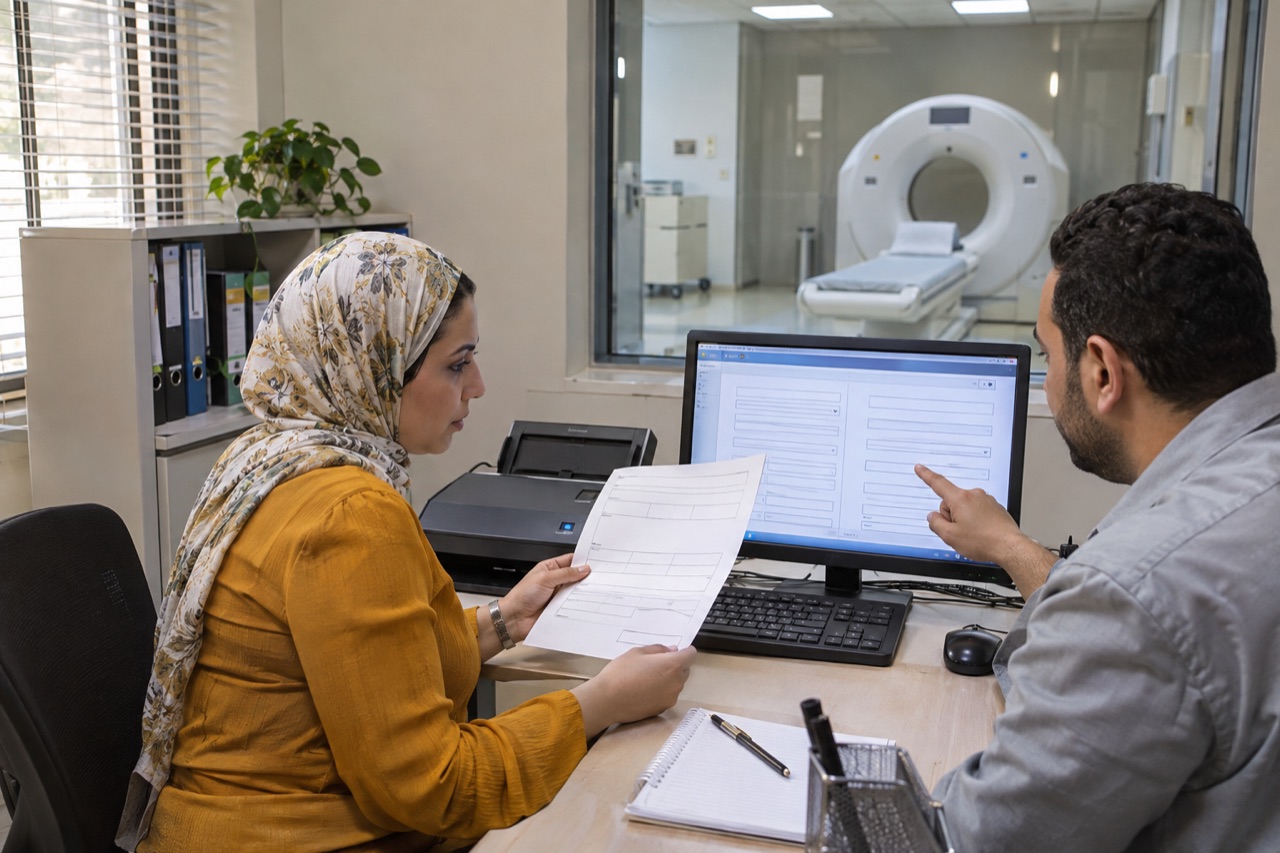
1. Define the data-entry problem
Map where a referral arrives, who reads it, who enters its administrative fields and where a correction is recorded. A radiology AI-integration primer emphasises workflow integration and local validation. [1] The proposal here is a narrow data-entry test, not an image-interpretation product. Do not assume an extraction tool can determine the appropriate examination, protocol, contrast use or urgency.
2. Agree on fields and a no-guessing rule
Define the authorised administrative fields, such as the referral date, ordering provider and centre-approved reference identifiers. Record any examination wording exactly as authorised for capture, without interpreting abbreviations or changing the clinical order. If writing is unreadable or a field is absent, mark it for human clarification rather than completing it from context. Clinical questions follow the approved professional workflow.
3. Understand what AI adds to text recognition
Text recognition reads characters; an AI-assisted extraction workflow may help organise text into an agreed field structure. Neither step makes the result correct automatically. Place the source document beside the draft fields and require a staff check before saving into the live system. WHO warns of false or incomplete generative output. [2] Test the actual tool and document types you plan to use rather than assuming a demonstration proves accuracy.
4. Keep saving and clinical decisions under control
A proposed pilot produces a draft only, with a visible review status and an owner. The authorised reviewer compares the required fields against the source and records corrections. Do not let the test automatically change appointments, clinical orders or a radiologist’s worklist. Any future integration needs its own authorised review of permissions, failure handling and responsibilities. A human check must remain meaningful rather than simply accepting a confident-looking draft.
5. Test with fictional referrals first
Use clearly fictional referral examples or properly de-identified material within an approved testing environment. Before any live personal data, review the vendor, storage, access, retention and export arrangements. Staff permissions, updated software and protected, tested backups support the basic security plan. [3] Do not upload actual referrals or patient images to an unapproved public AI tool or Eyadtak’s enquiry form.
6. Compare end-to-end handling time and field accuracy
For an agreed test set, count exact matches on required administrative fields, missing-field flags, incorrect guesses and human correction time. Compare the full process with current manual entry, including scanning, checking, correction and saving. Record rejected documents separately. This evaluation is a proposed local test, not a benchmark or a promised saving. Faster draft generation alone does not demonstrate a better workflow or financial return.
7. Request an assessment of the digital workflow
Describe the document types, current entry method and the bottleneck, without sending real referrals. Use the service button and choose Digital transformation to discuss available support and agree on scope, responsibilities and fees. This article is not a claim that Eyadtak operates a ready-made radiology integration. Research sources inform the discussion; they do not approve a particular deployment or replace applicable Egyptian requirements.
Sources and review method
Sources reviewed: 10 November 2026. General educational guidance for planning; adapt it to your specialty and applicable Egyptian requirements. Suggested examples and plans do not guarantee results.